
Komodo National Park
A UNESCO World Heritage sanctuary where prehistoric dragons roam volcanic islands, ancient savannas meet turquoise seas, and the Coral Triangle reveals its underwater masterpieces.
Where Land Meets Sea in Extraordinary Harmony
Established in 1980 and inscribed as a UNESCO World Heritage Site in 1991, Komodo National Park represents one of humanity's most successful conservation stories. Spanning 1,733 square kilometers across 29 islands in Indonesia's Lesser Sunda archipelago, the park protects not only the world's largest lizard — the iconic Komodo dragon — but also one of the richest marine ecosystems on Earth.
The park's unique position at the confluence of the Pacific and Indian Oceans creates extraordinary biodiversity. On land, dry monsoon forests and rolling savannas host over 200 terrestrial species. Beneath the waves, the Coral Triangle reveals its full splendor with over 1,000 fish species and 260 coral species thriving in nutrient-rich currents.
Today, with a carefully managed daily visitor quota of 1,000 people, Komodo National Park balances conservation with sustainable tourism. Whether you're trekking volcanic ridges, diving with manta rays, or simply watching the sunset paint Padar Island's three bays in gold, this is a place that transforms how you understand our natural world.
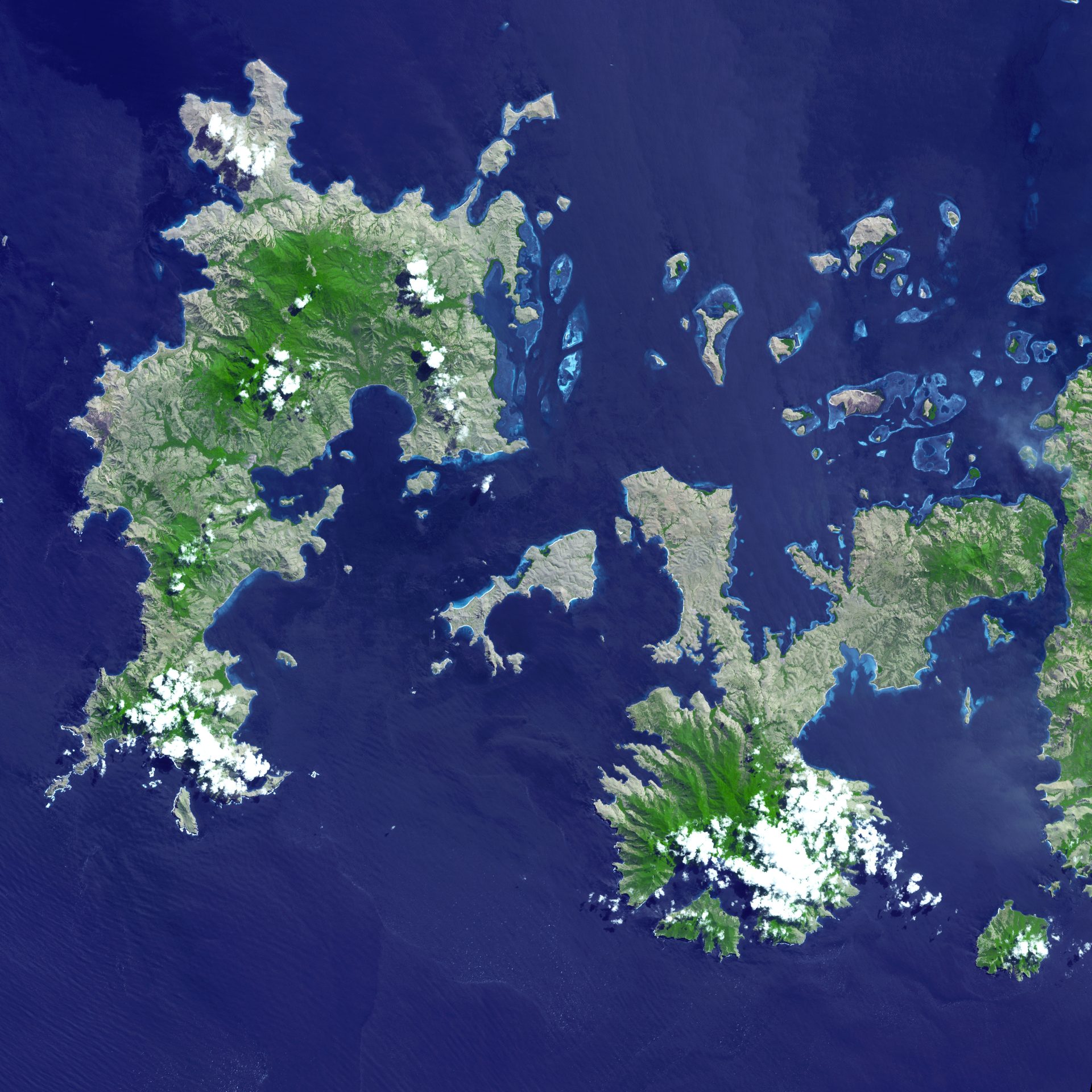
East Nusa Tenggara, Indonesia — between Sumbawa and Flores islands
Deep-Dive Articles
Expert-written guides covering every aspect of Komodo National Park — from its volcanic origins to its latest conservation regulations.
History of Komodo National Park and UNESCO World Heritage
From Dutch colonial expeditions in 1910 to UNESCO World Heritage inscription in 1991 — trace the extraordinary journey of how Komodo National Park became one of Earth's most protected natural treasures.
Geography of Komodo, Rinca, Padar, Gili Motang, and Other Islands
Navigate the dramatic volcanic landscapes, savanna hills, and hidden coves across 29 islands. Understand how each island's unique geography shapes its wildlife and visitor experience.
Komodo National Park Zoning and Latest Regulations 2026
Stay current with the park's visitor quota system, entry fees, activity zones, and conservation rules. Everything you need to plan a legal, responsible visit in 2026 and beyond.
Terrestrial Ecosystem of Komodo National Park: Savanna, Forest, and Land Life
Journey through dry monsoon forests, rolling savannas, and mangrove fringes. Meet the Komodo dragon and over 200 terrestrial species that call these islands home.
Marine Ecosystem of Komodo National Park: Coral Triangle and Underwater Wonders
Dive into the richest marine biodiversity on Earth. Over 1,000 fish species, 260 coral species, and legendary dive sites await in the heart of the Coral Triangle.
Park at a Glance — Designations & Governance
Key administrative facts drawn from UNESCO World Heritage records and the 2024 BAPPEDA Manggarai Barat Periodic Review.
| Attribute | Detail |
|---|---|
| Established as National Park | March 1980 (initial area 72,000 ha); extended 1984 to ~219,322 ha (~2,193 km²), adding marine zone & Flores parcels |
| UNESCO MAB Biosphere Reserve | Accepted January 1977 — predates National Park status |
| UNESCO World Heritage Site | Inscribed 1991, criteria (vii) (natural beauty) & (x) (biodiversity) — Site ID 609 |
| IUCN Protected-Area Category | Category II — National Park |
| Park surface (UNESCO boundary) | Terrestrial ~603 km² (60,300 ha) · Marine ~1,130 km² · Total ~1,733 km² |
| Biosphere Reserve full extent (2024) | 1,118,003 ha total — Core 173,300 ha · Buffer 288,353 ha · Transition 656,350 ha (BAPPEDA Manggarai Barat 2024) |
| Managing Authority | Balai Taman Nasional Komodo (BTNK) — Technical Implementation Unit, Direktorat Jenderal KSDAE, Ministry of Environment & Forestry (KLHK) |
| Management Zones (Master Plan 2000–2025) | Core · Wilderness · Tourism · Traditional Use · Special Use · Pelagic Use |
| International Recognition | New 7 Wonders of Nature finalist, 2011 |
Day-to-day management of the park rests with Balai Taman Nasional Komodo (BTNK), a field-level Technical Implementation Unit (UPT) of the Directorate-General for Natural Resources & Ecosystem Conservation (KSDAE) within Indonesia's Ministry of Environment & Forestry (KLHK). BTNK enforces the six-zone system defined in the park's 2000–2025 Master Plan: a strictly off-limits Core Zone, a low-impact Wilderness Zone, designated Tourism and Traditional Use zones that accommodate regulated visitor activity and local fishing, a Special Use Zone for infrastructure, and a Pelagic Use Zone covering open-water passages critical for marine megafauna.
The park's protection layers extend well beyond the UNESCO World Heritage boundary. The broader UNESCO MAB Biosphere Reserve — first designated in January 1977 and reconfirmed through the 2024 BAPPEDA Manggarai Barat Periodic Review — encompasses over 1.1 million hectares when the transition zone is included, providing a buffer of sustainable-use land around the inscribed core. This nested structure, from Pelagic Use Zone to Biosphere Transition Zone, makes Komodo one of the most comprehensively governed marine–terrestrial protected areas in Southeast Asia.
Sources: UNESCO World Heritage Centre — Komodo, Site ID 609; BAPPEDA Kabupaten Manggarai Barat, Periodic Review of the Komodo Biosphere Reserve, 2024.
Essential Park Facts
Established 1980, UNESCO 1991
One of Indonesia's first national parks, recognized globally for Outstanding Universal Value.
29 Islands, 3 Major Ones
Komodo, Rinca, and Padar are the primary islands, with 26 smaller islets and reefs.
Daily Visitor Quota: 1,000
Strictly enforced to protect ecosystems. Book permits well in advance during peak season.
Home to ~3,000 Komodo Dragons (~1,400 mature adults)
The last wild population of Varanus komodoensis, found nowhere else on Earth.
What This Means for You
- Plan ahead: The 1,000-person daily quota means last-minute trips are risky. Book 2-3 months ahead for peak season (June–August).
- Multiple experiences: With 29 islands, a 3-day liveaboard offers vastly more than a single-day speedboat tour.
- Year-round diving: The marine ecosystem thrives in all seasons, though visibility peaks during dry season (April–November).
- Conservation fees matter: Your entry fee directly funds anti-poaching patrols, habitat restoration, and dragon monitoring programs.
- Respect the zones: Certain areas are completely off-limits to visitors. Understanding zoning keeps you legal and protects wildlife.
Did You Know?
Komodo National Park is one of only a handful of places on Earth where you can see large terrestrial predators and world-class coral reefs in the same location. The park's "Twin Natures" — fierce dragons above and gentle manta rays below — make it a uniquely complete nature destination. No other UNESCO site offers this combination at scale.
Explore Other Pillars
Frequently Asked Questions
Quick answers to common questions about this topic.
Where exactly is Komodo National Park?
▼
Komodo National Park is situated in East Nusa Tenggara province, Indonesia, between the islands of Sumbawa and Flores in the Lesser Sunda archipelago. The park spans 1,733 km² across 29 islands — most notably Komodo, Rinca, Padar, and Gili Motang — and includes both terrestrial and marine zones. The gateway city is Labuan Bajo, on the western tip of Flores, approximately 500 km east of Bali.
How do I get to Komodo National Park?
▼
The main entry point is Labuan Bajo, reachable by direct flights from Bali (Ngurah Rai) and Jakarta (Soekarno-Hatta) via Komodo Airport (LBJ). Flight time from Bali is approximately one hour. From Labuan Bajo, visitors access the park by boat — either on a liveaboard cruise or a day-trip vessel. The SiOra online booking system is required for all visits and must be completed before travel, especially in peak season (June–August).
What does it cost to enter Komodo National Park in 2026?
▼
Entry fees for foreign visitors are approximately $15–30 per day, covering the national park admission. Additional costs include mandatory ranger escort fees, boat charters or liveaboard packages (ranging from $80 for a day trip to $300+ per night on a liveaboard), and optional diving permits. Fees are subject to adjustment and must be verified via the SiOra booking platform. A percentage of fees funds ranger salaries and habitat-restoration programmes.
When was Komodo National Park established and designated a UNESCO World Heritage Site?
▼
Komodo National Park was established in 1980, initially to protect Komodo dragons. In 1991 it was inscribed on the UNESCO World Heritage List, recognised for its outstanding natural values encompassing both the rare mega-fauna and extraordinary marine biodiversity. The park was also declared a UNESCO Biosphere Reserve. Its history stretches back to 1910, when Dutch colonial administrator Lieutenant Steyn van Hensbroek led the first recorded scientific expedition to Komodo Island.
Is it safe to visit Komodo dragons in the national park?
▼
Visits are safe when conducted under the strict protocols enforced by the park: tourists must be accompanied by licensed rangers, keep minimum distances from dragons, and follow designated trails. Komodo dragons have attacked and seriously injured visitors who violated safety rules. Rangers carry forked sticks to deflect aggressive animals. Solo trekking is prohibited. Following ranger instructions, wearing muted colours, and avoiding sudden movements around feeding areas significantly reduces risk.